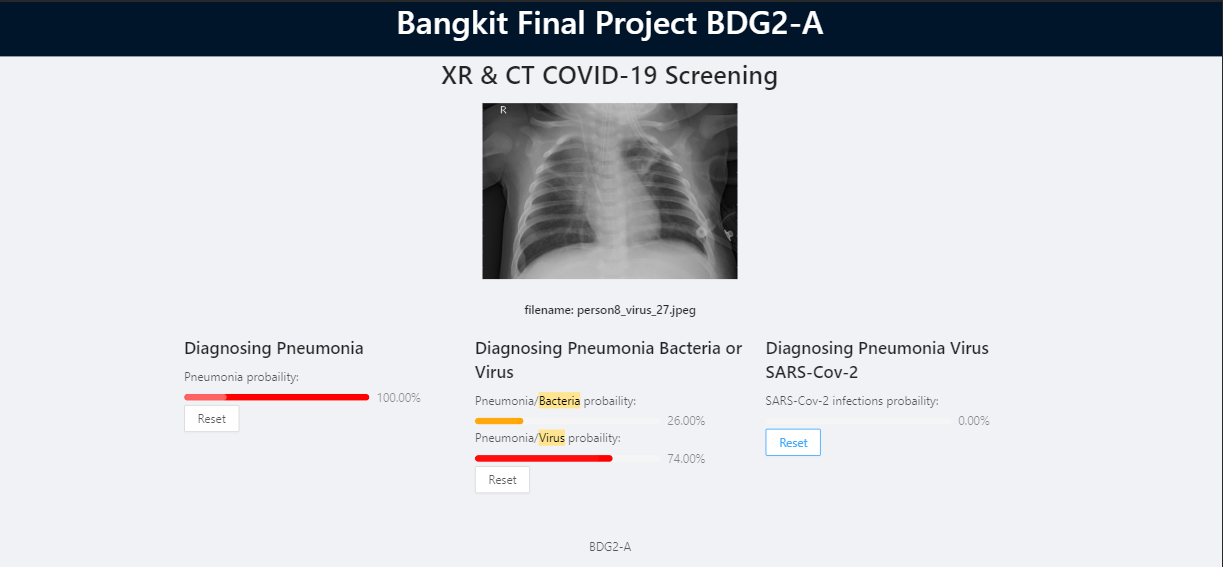
In the midst of the COVID-19 pandemic, rapid and accurate detection methods are crucial. While PCR tests are the standard, imaging techniques like chest X-rays have become valuable tools for diagnosis. Enter the ct-covid19-model project—a deep learning approach to identify COVID-19 from X-ray images.
Project Overview
This initiative leverages TensorFlow and Keras to develop a model capable of distinguishing between COVID-19 positive cases and others using chest X-rays. It’s part of the Bangkit Assignment 5, focusing on machine learning applications in healthcare.
Disclaimer: This project is for educational purposes and is not intended for clinical diagnosis.
Data Collection
The model was trained using two primary datasets:
-
COVID-19 Chest X-ray Dataset: Curated by Joseph Paul Cohen and colleagues, this dataset includes X-ray images of patients diagnosed with COVID-19.
-
Chest X-Ray Images (Pneumonia): Compiled by Daniel Kermany and team, this dataset contains X-ray images of patients with various types of pneumonia and healthy individuals.
From these sources, the project selected:
- 97 COVID-19 positive images (posterior-anterior view)
- 97 images of either healthy individuals or patients with other types of pneumonia
This balanced dataset of 194 images ensures the model learns to differentiate effectively between COVID-19 and other conditions.
Model Architecture
The project employs the VGG16 architecture, a well-known convolutional neural network, through transfer learning. Key specifications include:
- Learning Rate: 0.001
- Epochs: 25
- Batch Size: 8
- Optimizer: Adam
- Loss Function: Binary Crossentropy
The dataset was split into 80% for training and 20% for testing.
Performance
The model achieved impressive results:
- Accuracy: Approximately 97%. The model got 97 out of 100 cases right.
- Sensitivity (True Positive Rate): 100% It found all the sick people without missing any.
- Specificity (True Negative Rate): 95% It correctly identified most healthy people, with a few mistakes.
These metrics indicate the model’s effectiveness in identifying COVID-19 positive cases while minimizing false positives.
Conclusion
The ct-covid19-model demonstrates the potential of deep learning in medical imaging, especially for rapid COVID-19 detection. While promising, it’s essential to remember that this model is a proof of concept and not intended for clinical use. Further research and validation are necessary before considering deployment in healthcare settings.
For those interested in exploring or contributing to this project, the code and resources are available on GitHub. Collaboration and continuous learning are key as we navigate the challenges posed by the pandemic. Stay safe and keep innovating! 🚀